Showing posts with label Christmas Mourning. Show all posts

Sunday, November 14, 2010

Christmas Is A-Coming!

Yesterday afternoon, CHRISTMAS MOURNING was finally and officially launched at Quail Ridge Books and Music in Raleigh. The only reason my signing could be rescheduled so quickly after my accident is because three of the major colleges in the area had football games and QRB’s canny events coordinator knows that can mean snarled traffic on I-40.

Despite the games, there was a good turnout and we served small nuggets of fruitcake and steaming cups of coffee. There were the usual snide remarks about fruitcake, followed by questions about Kezzie’s peach brandy that Deborah’s Aunt Zell uses to keep her cakes moist. I observed that rum or bourbon could work too. “So is yours drenched in rum or bourbon?” store owner Nancy Olson asked.

“Not rum,” I said. It took a moment for my answer to sink in amid the laughter.

Until now, HIGH COUNTRY FALL has occasioned the most requests for recipes, but I have a feeling this book is going to get its share. So many people have already asked about the chocolate covered fried pecans and for the bourbon balls that I’m going to give the recipes here so that those who want to can go ahead and make the bourbon balls now and let them ripen.

Bourbon Balls

Pour ½ cup bourbon over 1 cup finely chopped pecans in an airtight container and let soak overnight. Next day, thoroughly combine 3 cups of crushed vanilla wafers, 1 cup powdered sugar, 1 stick of softened butter.

Add pecans, bourbon and all, plus another ½ cup of bourbon.

Stir well and form into balls about half the size of a golf ball. Chill until hardened.

Melt together a 12-oz bag of chocolate chips, a half-stick of butter, and 1 oz. of bar paraffin.

Working quickly, dip the chilled balls in the chocolate and place on a cookie rack over a sheet of waxed paper. Drips can be scraped up and remelted as needed.

Store in an airtight container in the refrigerator for at least a week.

Makes about 45.

Chocolate-Covered Fried Pecans

Melt half a stick of butter in a large iron frying pan. Add 2 cups pecan halves. Over moderate heat, stir constantly. Remove from heat before the nuts are completely toasted because they will continue to coof for another minute or two. Salt and chill.

Melt together chocolate chips, butter, and a tiny bit of paraffin. (Amounts depend on whether you want to thoroughly coat the nuts or use just enough to get the full contrast of sweet and salt, my preference.)

Line 2 large baking sheets with waxed paper. Spread the pecans on the waxed paper, one layer deep, and drizzle the chocolate over them. Chill. When hardened, break up into chunks and store in an airtight tin.

* * * *

And for what it’s worth, if you don’t have an Aunt Zell to bake you a fruitcake, almost any good commercial cake will improve with age if you wrap it in cheesecloth four or five weeks before serving and keep the cheesecloth well-moistened with bourbon or rum or—if you must—even apple juice.)


Saturday, October 30, 2010

CHRISTMAS MOURNING Is Finally Here!


November 1 is the official launch party for Christmas Mourning at Raleigh's Quail Ridge Books and Music, 7:30 p.m., although it has been available for at least a week. If you are on my eList, you received the following excerpt a couple of weeks ago. This link (http://www.youtube.com/watch?v=k08wEGekzkI) should take you to a short video that was made in my home. If not, go to YouTube.com and enter “Margaret Maron’s Christmas Mourning” in the search box. Hope it whets your appetite for the whole book!

Excerpt from Christmas Mourning

This scene takes place a few days before Christmas. As a surprise gift for Deborah and Dwight, her nieces and nephews have rigged up colorful lights for the pond. When they get home that evening, they find most of her family around a bonfire down by the pond:

The colored lights that shimmered on the surface of the water must have revived ancient memory because when there was a lull in conversation, Daddy said, “I ever tell y’all about the first Christmas after my daddy passed? The tangerines?”

There was a chorus of noes from his grandchildren and calls of “Tell us” from my younger brothers and me. Robert, being the oldest, smiled as if he knew the story and already anticipated our reaction.

“Well,” said Daddy, “the way it was is that I was still three months shy of turning fifteen when my daddy died and left me the man of the family. There was Mammy, and Sister and Rachel and the twins . . .”

His voice always trails off whenever he mentions his younger twin brothers, Jacob and Jedidiah. Jacob had drowned in Possum Creek when the two were sixteen and Jed immediately ran away, lied about his age, and joined the army. He was killed in a training exercise at Ft. Bragg before he ever got out of the state.

“Anyhow, it was getting on for Christmas and we was poor as Adam’s housecat. Mammy’d already told the little ones that Santa Claus probably won’t gonna be able to find our house, but they didn’t believe her and just kept talking about what they was gonna find in their stockings. Mammy’d made a rag doll for Rachel outten a flour sack she’d bleached white and did its hair and pigtails with tobacco string. Sister’d used pokeberries to dye a sack purple and stitched up a little doll dress and bonnet. I whittled out new slingshots and whistles for the boys and Mammy’d sent me over to the store to trade some eggs for a little poke of Christmas candy, but all the same, it was looking like a mighty thin Christmas.”

Tenderhearted Ruth, who was seated on the tarp nearest him, squeezed his wrinkled hand and said, “Oh, Granddaddy, you must’ve felt just awful.”

Cal was solemn-faced, as if trying to get his mind around a Christmas with nothing plastic or electronic under the tree.

“Now right before Christmas, there come a rain like I ain’t seen in no December before nor since. Was like a hurricane only not no wind, just a hard, hard rain coming straight down like water outten the pump in our kitchen sink. Possum Creek flooded something awful. Getting on toward nightfall next day, a truck drove into the yard and it was a man up from Florida looking to buy a couple of jars of whiskey from my daddy. Said he had two more deliveries to make over in Cotton Grove and he needed something to keep him warm on his trip back home, ’cause he was freezing to death up here.”

Daddy paused and gave a foxy grin. “He must’ve finished off a jar of something a little earlier though, ’cause it struck me that he was well on his way to being right warm already.

“Well, he left when we told him Daddy was gone, but it won’t thirty minutes till here he come again, walking this time. His truck’d got stuck trying to cross the creek and he wanted me to help him get it out. See, the road won’t paved back then and the bridge was down almost level with the water, so mud was up to his axles before he ever got to the bridge. He said he’d give me fifty cents if I’d help him. Back then, fifty cents was like five dollars now, so I went right out to the lot and hitched up ol’ Maude.”

“Who was ol’ Maude, Granddaddy?” Cal asked.

My heart lifted at his unconscious use of that name because it meant that he felt himself a part of my family.

Best mule we ever had,” Daddy explained. “Strong as a Cub tractor and biddable as a dog.”

High praise indeed.

“When we got down to the creek, we unloaded the back of the truck to lighten it some and I seen he was carrying a pile of Florida fruit. Wood crates of oranges, tangerines, and some big yellow things I ain’t never seen before. First time I ever laid my eyes on grapefruit.

“We stacked them boxes up on the creek bank and I tied a rope from Maude’s traces to the back of the truck, then that man heaved on one side and I heaved on the other and little by little we could feel it start to pull loose.

“The thing was though that Maude was a-straining so hard that just as the truck come free, she let loose with a load of her own and the man stepped right in it. Well, sir, he jumped back and when he did, his feet slid out from under him and he flailed back into that pile of crates. ’Fore you could say Jack Robinson, two crates of them tangerines tipped over and went tumbling down the creek bank where they busted open on the rocks and the high water just carried ’em right away.

“That man was cussing Maude and cussing me and even though I helped him load the truck back up, when I asked him for my fifty cents, he told me I oughta be a-paying him fifty cents for them tangerines and he just drove off without a thank-you or a kiss-my—”

At this point, Daddy broke off and lit a cigarette to cover his chagrin at nearly using a crude expression in mixed company.

“So what’d you do, Granddaddy?” asked Annie Sue.

“Won’t but one thing I could do,” he told her. “I took Maude back to the mule lot and got my dip net and a gunnysack and went down to the fish trap I had rigged up a little further down the creek. Sure enough, when I got to it, there was all them shiny orange tangerines bobbling around in amongst the brush that’d got backed up from my trap. Took me almost a hour to fish them all out and lug that gunnysack back up to the barn. I give Mammy enough so everybody’s stocking got tangerines, even mine and hers. Then I lugged the rest of ’em to Cotton Grove and traded for some store-boughten stuff Mammy’d been needing. Thanks to ol’ Maude, it was a real fine Christmas.”

Saturday, October 16, 2010

Keeping Them Straight


This is a weird time of year for me when I have to try to keep three of my books straight in my head.

Sand Sharks, my 2009 book, came out in paperback this past week. Christmas Mourning, the 2010 book comes out the first week in November.

I've been trying to remember all the plot lines and plan what I'll read and talk about at the launch party on 1 November at Quail Ridge Books and Music at 7:30. (Come by for a glass of wine and some brie and crackers if you're in the area.) All this while I'm trying to write the last few chapters of Three-Day Town, the 2011 book. (And let's don't even talk about the 2012 book which doesn't yet have a title, a killer, or a victim, but does have a few stray thematic strands.)

Christmas Mourning is the 16th to feature Judge Deborah Knott, and, as may be guessed, has a holiday theme that draws on my own past and present memories of Christmas. While Halloween trick or treaters may be ringing the doorbell on the night of October 31, I'll be selecting Christmas passages to discuss the following night.

Really, shouldn't there be a turkey somewhere in here, too?


Sunday, October 3, 2010

CHRISTMAS IN OCTOBER


Outside, leaves are beginning to show a faint hint of fall’s changing colors. My summer flowers are still blooming profusely, roses are still sending out new buds, and even the magnolia has decided it could get in another few fragrant blossoms.

Inside, it’s beginning to look a lot like Christmas.

Or so I hope.

A videographer is coming this morning to film a trailer for Christmas Mourning, which is due out in November. I will talk about Christmas in Deborah Knott’s Colleton County and I’m hoping I’ve scattered enough candles and greenery around to set the mood. I’m trusting that the camera’s eye will not stray to the windows where trees in full leaf can still be seen nor note that there is no fire burning on the hearth.

But I do love Christmas and even though it’s October, I will enjoy talking about the holiday season and getting a small preview of December. I may tell how tangerines will always be the smell of Christmas morning for me. That was the only time we had them when I was a child. My mother used to put at least two in each stocking because they took up so much space she hoped we might not notice how little Santa had left us. In the book, Kezzie Knott has his own memory of Christmas tangerines and it involves the best mule he ever owned. I hope it will make you laugh and call up your own holiday memories.


Saturday, November 28, 2009

Weymouth Again


Once again, six of us headed out to the Weymouth Center for the Arts in Southern Pines (www.WeymouthCenter.com) last week for our fall writing retreat.  There are actually seven of us who cycle in and out, depending on schedules, but very seldom can we get seven schedules to mesh and this year was no exception.

 [Pictured left to right: Katy, Alex, Diane, me, Sarah, Mary Kay.]

Mary Kay Andrews (aka Kathy Trocheck), Sarah Shaber, and Alexandra Sokoloff were the first to arrive.  Diane Chamberlain, Katy Munger (aka Chaz McGee), and I trickled in over the next three days and we all wished Brynn Bonner could have been with us. 

Alex had used a fictionalized version of Weymouth as one of her settings in The Unseen and was a bit spooked to discover that some of the things she had made up were actually real.

I hoped to get a running start on the 2011 book (and did!), but first on my “must-do” list was to go over the copy edit of Christmas Mourning, which will be out next November.

Mary Kay was a hundred pages into her next book, while the others were still at the plotting and planning stages and needed to brainstorm ideas at the morning meeting.

After setting our goals for the day, we scattered to various corners of that gracious old house to work.  It’s hard to describe the synergistic effect of knowing that your colleagues are nearby, immersed in the creative process.  Pride was a sharp spur that kept us at our keyboards when the muse wanted to go wandering down to the kitchen or curl up for a quick nap.  No one wanted to have to face the others and admit that she hadn’t accomplished what she said she would. 

It wasn’t all work, of course.  We took turns cooking supper and afterwards we would check our email, Facebook pages, whatever.  More brainstorming and plotting, then a few word games, a glass of wine or handful of M&Ms, and so to bed.

Did we accomplish everything we hoped?  For the most part, yes, we did.  By the time we meet down in Georgia next spring, Mary Kay may be finished with her book and the rest of us will have a very good idea of where our own books are going.


Sunday, October 25, 2009

Return to the Scene of the Crime, Part II: Sand Sharks

This posting is a day late for a couple of reason.  As I write it, I’m in a hotel in Wrightsville Beach right next door to Wilmington where much of the action of Sand Sharks take place, but my internet connection is too iffy to connect properly and I forgot to pack the little gizmo that sends pictures from my camera to my laptop.

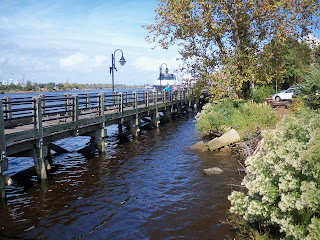
After lunch at “Jonah’s” yesterday, we walked along the River Walk and took pictures of the exact spot where a judge’s body was found.  

The log that you see here below is the twin of one Deborah thought she was seeing when she originally spotted him.

In the spring of 2008 when I was first began the book, Megan Verlee, a young reporter from the local NPR station and one of my courtesy nieces, offered to drive me around Wilmington and show me aspects I might have missed on earlier visits.  We were down on the River Walk when I came across this site.  “It’s perfect, “ I said, snapping away with my camera.  Megan pointed out the craggy branches that might catch and hold the dog leash with which the judge was strangled. 

We were so absorbed that we didn’t notice that someone had paused to watch until we heard a cultured South Carolina accent from behind us.  “Excuse me?”

We turned and saw an elegant older woman in pearls and a designer suit.  “May I ask what y’all are looking at?”

Megan’s eyes danced with mischief.   “We’re just looking for a good place to dump a body.”

Without blinking or missing a beat, the woman said, “Oh my.  Now isn't that interesting?” and drifted on down the River Walk.

By the time you read this, I will have met with my judge friends here and heard their critique of the legal aspects of Christmas Mourning, which is tentatively scheduled for November 2010.

(Postscript:  Happily, they say I didn’t let Deborah make any reversible errors in her courtroom rulings!)


Sunday, October 4, 2009

Thoughts upon Finishing Another Book

Ten or fifteen years ago, I used to be asked if switching from a typewriter to a computer had changed the way I wrote.  This is not a question I get much any more as typewriters recede into the mists of time, but every time I finish a book, I can’t help comparing the differences. I’ve seen over the years.   

My first few books were written on the Smith-Corona manual portable typewriter that I took to college with me.  If I made a mistake, I had to reach for the bottle of White-Out.   
Then came my first electric typewriter with a ribbon that was half-correction tape.  If I backspaced and retyped the error, the correction tape would lift the ink off the page.  No more buying White-out by the quart.  I felt as if I were really stepping in high cotton!    

Even with the electric model though, when I finished the final draft of the book, I knew I had 72 solid hours of typing to produce a clean copy for my editor.  As I typed, I would occasionally realize that a later scene really ought to come earlier in the book.  But was it worth retyping 50 pages for a slight improvement?  I didn’t think so.   

My first computer was a dot-matrix miracle.  I could cut-and-paste electronically.  Move scenes.  Reorder chapters.  So yes, the computer did make me a better writer.   And when I was finished, the printer could churn out a complete manuscript in only five or hours instead of 72!  Of course, the pages came out in one long continuous sheet, but so what?   Tearing on the dotted lines and trying not to mix up the pages, I felt as if I were on the cutting edge of technology.   

Now, of course, I have a plain paper printer and when I printed out Christmas Mourning this past week, it took much less than an hour and the pages were collated.   

Twenty odd years ago, I remember reading that Arthur C. Clarke had just sent his latest book to his editor via something called the Internet.  The process sounded like something out of one of his SciFi books.  This weekend, I e’d the manuscript to my agent’s Kindle.   

What would Jules Verne make of that? 


Sunday, September 20, 2009

’Twas the night before Christmas and all through the house . . .

The last of summer’s tomatoes are dribbling in and last week I made ketchup.  Nothing to it, right?  Just stew down the tomatoes, sieve out the seeds and skins, add a little vinegar and seasonings and there you are, right?

Wrong.                                               

It’s very hard to make something you don’t like as much as I don’t like ketchup.  Even harder is trying to correct the seasonings on something hot that’s supposed to be eaten cold.  Very difficult to judge if everything's in the right proportion.

And what does making ketchup have to do with Christmas?

Ever since May, through the heat of June, July, and August, I’ve had to immerse myself in thoughts of December’s chill while sweltering under a summer sun, to picture sleet storms and icy winds while wilting in front of a fan, to think of carols and fruit cake while beach music is playing and hot dogs are cooking on the grill—in short, trying to write a Christmas book in summer is very much like making ketchup when you’re not sure how it’s supposed to taste.

If all goes well, Christmas Mourning, the sixteenth Deborah Knott novel, will be out next August and it will feel like a traditional holiday book.  It’s set in Colleton County again and I’ve spent the last week tweaking and polishing and adding a few scenes.  To further confuse me though, Sand Sharks, came out last month.  This means that while one part of my brain was immersed in Christmas, the other part had to focus on the beach, the heat, and the judges’ summer conference that Deborah was attending because I’m still giving readings and signing this book.

After I finish the rewrite on CM, my editors will send it to a copy editor, who checks for spelling and punctuation and consistency (someone who’s been charged with blowing a point-ten in Chapter 3 should not be pleading guilty to blowing a point-twelve in Chapter 6, nor should a character with blue eyes have brown eyes forty pages later.)    


I figure this book should be whipped into shape right around Halloween.  Just in time to start planning for Christmas.  Pass the ketchup, please.  Oops! I mean the cranberry sauce.


Sunday, August 2, 2009

Figs!


In our garden, tomatoes, peppers, and okra come into their own this time of year, but they are outshone by the figs that are ripening by the gallon on our three bushes.  The birds and the june bugs are drunk on their soft sweetness and so are we.

In my last book, Death’s Half Acre, my protagonist, Judge Deborah Knott, was apprehensive when her new husband, Sheriff’s Deputy Dwight Bryant, planted a garden that kept getting bigger.  “I don’t can and I don’t freeze,” she warned him.  That book ended before the garden began to bear and she’s off to a judges’ conference at the beach in Sand Sharks, so I don’t really know if she’s going to carry out her threat.

Somehow I doubt it.

Like me, Deborah grew up on a working farm and did her share of peeling tomatoes, shelling beans, and picking fruit, so I find it hard to believe she wouldn’t want to put a few packages of homegrown vegetables in the freezer or stir up at least one batch of jam.

Even though I’m coming down to the wire with my 2010 book, I had to take some time off this past week and dig out my aunt’s recipe for fig preserves.  Once upon a time, I used to make jams and jellies from every fruit on the farm, but several years ago I noticed that the jars that disappeared quickest from the pantry shelves were the fig preserves.  I cut back on the strawberry, blackberry, apple, and blueberry jams until now this is the only fruit I put up.  I even make enough to send some home with houseguests who rave about it after eating it for the first time on breakfast biscuits or toast.  It’s a super-easy recipe, so if you have access to figs, try this:

AUNTIE’S FIG PRESERVES

• In a large pot, layer 8 lbs of figs and 5 lbs of sugar and 1 diced whole lemon (minus the seeds and white internal membranes.)  Refrigerate overnight.

• Add 1 – 2 tablespoons pickling spice.

• Boil till thick and translucent, then seal in clean hot jars.

• Makes about 10 pints.

If your jars, rings and lids are all good and hot (I keep mine in a roasting pan in the oven at 225° until ready to fill), the jars will seal without a pressure canner or water bath.

I’ve almost finished writing Christmas Mourning, and I haven’t yet taken a peek inside Deborah and Dwight’s pantry, but I’m willing to bet that there’s at least one batch of fig preserves on the shelf.


Blog Archive