Showing posts with label Last Lessons of Summer. Show all posts

Monday, March 21, 2011

Last Lessons of Summer

Index to study guides/ book club questions / background:

Bloody Kin – 9 January 2011

Bootlegger’s Daughter– 16 January 2011

Death’s Half Acre – 23 January 2011

Hard Row — 6 February 2011

Last Lessons of Summer — 21 March 2011

One Coffee With – 30 January 2011 (Now on Kindle and Nook)


Background:

Several threads went into the plot of this book: (1) Years ago, I read that A. A. Milne’s son, the real Christopher Robin, was resentful that his dad had co-opted his childhood stuffed animals and imaginary world so I gave an exaggerated situation to a little girl named Maxine, Maxie for short. I made her parents a failed poet and a gifted illustrator who were so wrapped up in each other that they had little affection left for the child; (2) my own fascination with Argiopes, the common orb-weaving “writing” spiders; (3) a lovely “recovered memory” triggered by my first full-body massage; and (4) the realization that not every family clings to its ancestral land and that many are more than happy to sell the family farm to developers.

Last Lessons of Summer is a standalone novel set in “Colleton County,” the fictional home of Judge Deborah Knott. The crimes are investigated by two men close to her, SBI Agent Terry Wilson and Major Dwight Bryant of the Colleton County Sheriff’s Department, yet she herself does not appear in this book.

Instead, this is a coming-of-age story about New Yorker Amy Steadman, a children’s book illustrator, who has inherited from her grandmother the controlling interest in a merchandising and publishing empire centered in Manhattan. She has also inherited the house where that grandmother was murdered and where that her own mother committed suicide when Amy was only a toddler.

An outsider with no sentimental ties to the land, Amy comes down to North Carolina to dispose of the house and her grandmother’s papers. In reconnecting with the relatives who still live on the farm, Amy hopes to learn why Maxie killed herself and whether her grandmother’s death was a robbery gone wrong or deliberate murder. Her cousin Curt tells her, “You have the right to ask those questions but you might not like all the answers you’re gonna get.”

Discussion points:

● How does the myth that has grown up around the origin of Pink and Blue differ from the reality of their first appearance at that 1938 baby shower?

● One of Frances’s coworkers declares that she’d rather have a tugboat for a husband than a dreamboat. Discuss.

● How does this baby shower foreshadow the rest of the book and even affect Frances’s granddaughter years later?

● At one point, Amy asks her stepbrother why he got to call her father Dad, but she was never allowed to call his mother Mom. How did that simple difference affect the dynamics of the blended family?

● Amy’s younger sister Beth unwittingly causes Amy to recover a crucial memory. Has something similar ever triggered your own memory of something you had completely forgotten?

● Beth tells Amy, “You’ve never had to worry about money. What’s pocket change for you might be a fortune to someone else.” One of the sub-themes of the book is power and money—who has it and who wants or doesn’t want it. Did you find the final division of PBM’s labor and power logical and fair?

● In the end, has Amy chosen her future or has she settled for it?


Sunday, September 21, 2008

All the Sex and Violence I Had to Leave out of Last Lessons of Summer

Part of the joy — and sometimes part of the curse — of being a writer is the way we experience things doubly.  By this, I mean that even as we’re living in the moment, there’s some small part of us that stands half a step back, coolly taking notes, observing precisely how it is, how it feels, when our hearts are breaking or swelling with love and pride for those nearest and dearest.  Directly or indirectly, everything is grist for our mills.  Some of it is conscious, much of it is subconscious, but when the time comes to write the scene, we have that observer’s notes to draw from.  We can happily waste hours on less serious things, too, knowing that somewhere down the line, those hours will find their way through our fingers to the keyboard and onto a printed page.  


Except when it doesn’t.


Example:  When I first started planning Last Lessons of Summer, a stand-alone book that came out in 2003, I thought I would finally be able to use some of the interesting lore I’d picked up from my hours and hours of watching spiders.


Spiders?  


Yeah, yeah, I know.  Creepy crawly yucky creatures.  The stuff of nightmares.  One of the two reasons, according to the old joke, God invented men.  (To move heavy furniture and kill spiders.)  Remember those old Grade B movies where the heroine is menaced by huge hairy tarantulas?  Remember Manhattan and how freaked Diane Keaton was by that spider in her shower?


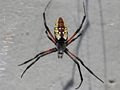
Well,  forget them.  Those were not the spiders I wanted to write about.  No, mine is the elegant black-and-yellow argiope, aka, appropriately enough,  the common writing spider because of her habit of “writing” Zs down the center of her web.  Unlike her free-ranging hunter cousins, the argiope is an orb weaver and she pretty much stays on it unless frightened off by bumbling humans.  She doesn’t seem to hear very well and she’s so near-sighted that an observer can get nose-to-nose with her.


So how can she survive, hanging upside there in the center of her web, half blind, nearly deaf?

Once I got past my arachnophobia, I saw that each of her eight legs was poised against a ray that ran from the center of the web out to its edges.  When something flew or fell into those sticky strands, she instantly oriented herself toward it.  If the insect struggled to free itself, she was on it in a heartbeat, wrapping it neatly in a band of silk a half inch wide before giving it the kiss of death.


But what really fascinated me was when she became sexually mature in late summer and attracted the attention of a male argiope.  I watched the whole courtship with voyeuristic interest and took so many rolls of film, I felt like a PI gathering evidence for a divorce court.  Arachnids don’t make love like you and me.  Nor do they mate like mammals.  I won’t go into the details here—this is after all, a PG-rated page.  Suffice it to say that pheromones dictate the action, and action there is.  


According to the field guide I was using, “Argiopes do not necessarily eat the male after mating.”  Not true.  If he escapes with his life, it’s not for lack of trying on her part.  The most horrifying session came when the smaller male slipped under her and deposited his sperm in her gonopore.  She instantly closed on him, but he managed to drop to the edge of the web.  Only six legs were left intact though, and the two he’d left behind were hardly enough to satisfy her ravening appetite. 


In the most grisly display of cold-blooded determination I have ever seen, she now began to pluck the rays of her web to discover where he was cowering.  “Here, dear?  On this one?” She plucked another.  “Are you here, my darling?  No?  What about—ah! There you are!” 


Before the poor dazed male could gather his wits and flee, she was on him.  A moment later, he became her first post-coital meal, protein for the eggs that would soon be swelling inside her.


It seemed to me that the things I’d learned about spiders would admirably suit my new book about a young New York publisher who comes down to North Carolina to clean out the house where her mother committed suicide years ago, and where her grandmother  was murdered only three months earlier.  I would make the mother an amateur naturalist and lend her my journals.  The spider actions would parallel those of the amoral grandmother.   Two thirds of the way through though, I finally admitted to myself that it wasn’t working.  


No matter how much I wrenched them, there was no way that the spider’s acts would resonate with the grandmother’s.  Reluctantly, I deleted all the arachnid sex and violence.


There was enough of the human kind left, of course.  


All the same . . . hey!  Wanna see some dirty pictures?


[There's still time to enter the sweepstakes to win an armload of my books. See the September 5 entry for details]


(Click here to read a sample chapter of Death's Half Acre.)


Blog Archive